
Foreign exchange
Forex
The foreign exchange market is where currencies are bought and sold against each other, around the clock, five days a week. This page explains how it works and what to understand before you ever place a trade.
Trading foreign exchange and crypto-assets carries a high level of risk and may not be suitable for all investors. Content on this site is educational and does not constitute investment advice.
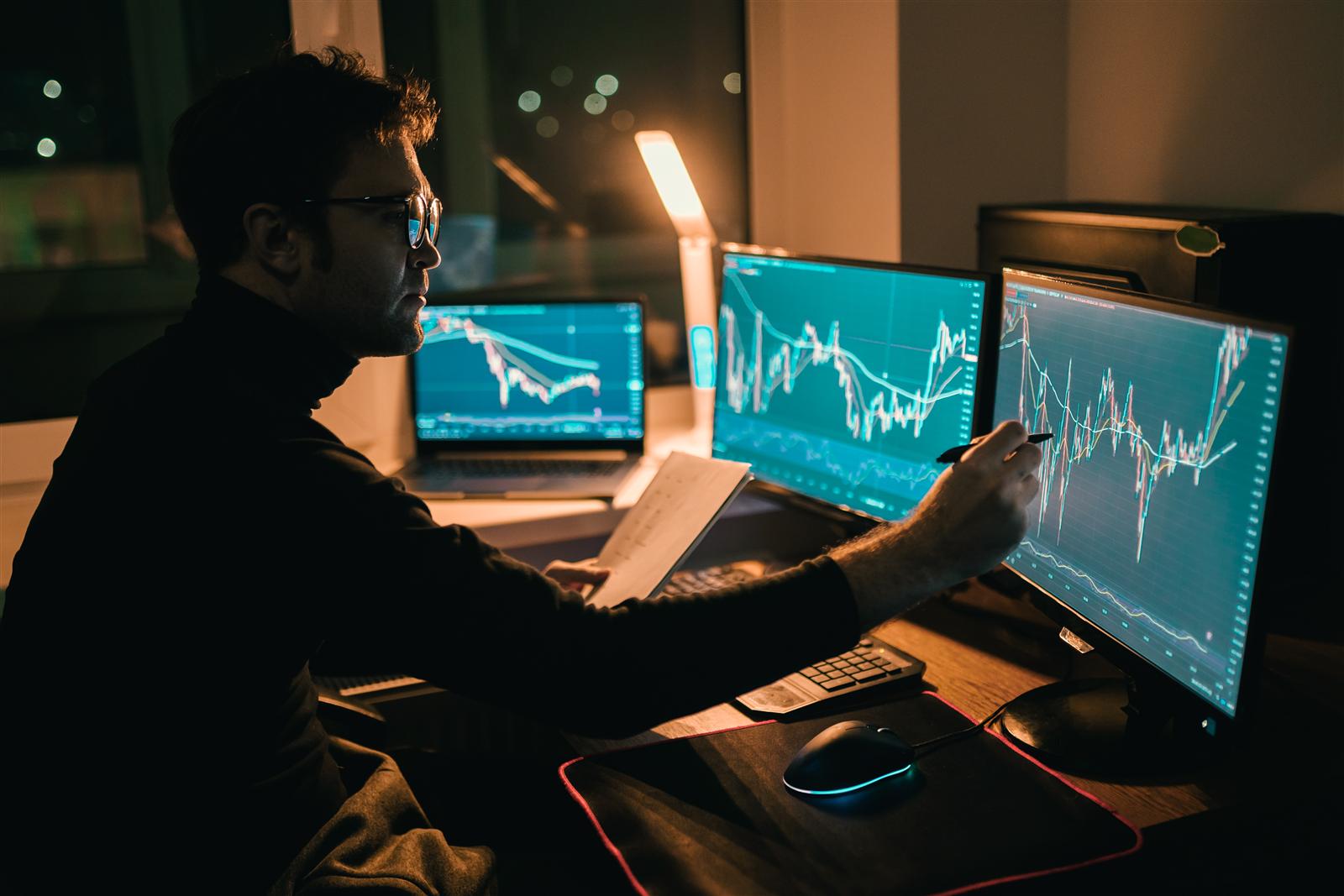
What is Forex?
Forex (FX) is the global market for exchanging one national currency for another. Prices are quoted in pairs — how much of one currency buys one unit of another — and they move as trade flows, interest rates, and expectations change.
It is the largest financial market in the world by volume, decentralised across banks, brokers and electronic venues rather than a single exchange.
How Forex trading works
A trader takes a view that one currency will strengthen or weaken against another and opens a position in that pair. Profit or loss is the difference between the entry and exit prices, multiplied by the position size.
Many retail products use leverage, which magnifies both gains and losses. Understanding position sizing, spreads, and how leverage changes your risk comes before any strategy.
Reference
Major currency pairs
The majors are the most traded pairs, typically with the tightest spreads and deepest liquidity.
| Pair | Currencies | Live rate | What tends to drive it |
|---|---|---|---|
| EUR/USD | Euro / US dollar | 1.0842 +0.12% | ECB and Federal Reserve policy, eurozone and US growth and inflation data. |
| GBP/USD | British pound / US dollar | 1.2695 -0.08% | Bank of England decisions, UK data, risk sentiment. |
| USD/JPY | US dollar / Japanese yen | 149.8200 +0.24% | Interest-rate differentials and the yen's role in risk-off periods. |
| USD/CHF | US dollar / Swiss franc | 0.8815 -0.05% | Safe-haven flows and Swiss National Bank policy. |
| AUD/USD | Australian dollar / US dollar | 0.6512 +0.18% | Commodity prices and Chinese demand. |
| USD/CAD | US dollar / Canadian dollar | 1.3564 -0.11% | Oil prices and Bank of Canada policy. |
Prices as of 16:26 UTC
Indicative prices, delayed and refreshed periodically. Not real-time data and not a basis for trading decisions.
Market analysis
Three ways to read a market
Analysts combine these lenses; none of them predicts the future on its own.
Technical analysis
Studies price and volume history — trends, support and resistance, indicators — to frame probabilities, not certainties.
Fundamental analysis
Looks at interest rates, inflation, growth and policy to judge whether a currency is likely to strengthen or weaken over time.
Sentiment analysis
Measures positioning and mood in the market, which often explains moves that fundamentals alone cannot.
Education
Learn Forex step by step
Our education section takes you from the basics of currency pairs to strategy and risk management, in your own time.
Go to educationRisk management
Before you trade
- Leverage magnifies losses as much as gains; only risk capital you can afford to lose.
- Define the maximum loss per position before entering, and respect it.
- Volatility around news releases can move prices through your levels.
- Past performance of any strategy does not guarantee future results.
Market updates
Forex market updates
EUR/USD: range-bound into the ECB decision
The pair held between 1.07 and 1.09 this week as traders positioned ahead of Thursday's rate decision.